Apex Drawdown Zero V12 Review: Gold EA Backtests, FTMO Mode and V12 vs V9
Published Sep 24, 2026, 10:40 PM · 9 min read
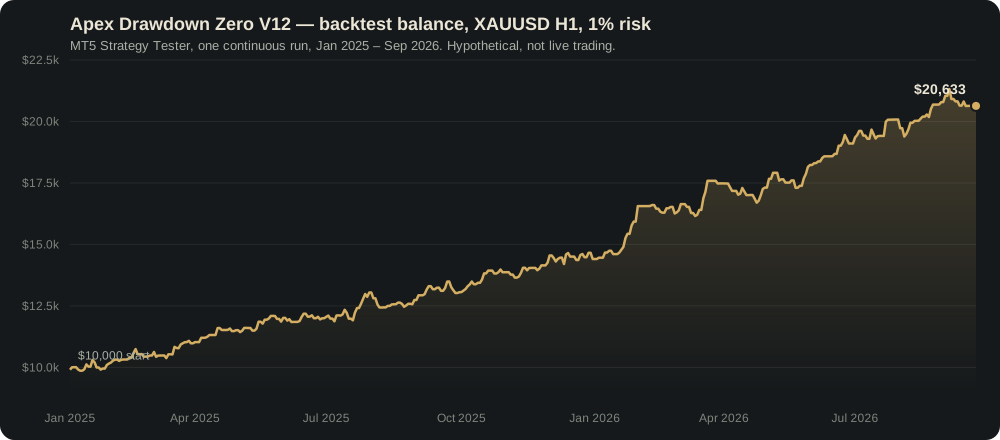
Apex Drawdown Zero V12 is a MetaTrader 5 Expert Advisor for gold (XAUUSD) on the H1 chart. It runs two strategies in separate lanes behind one risk firewall, and it has four modes, one of them built for FTMO-style prop-firm challenges. In the MetaTrader 5 Strategy Tester it made +44% in the held-back 2025 test year at 1% risk, with a 4.7% maximum balance drawdown. With real tick data it passed 12 of 12 simulated FTMO phase-1 challenges.
V12 is not an update to Apex V9. It is a separate edition, V9 stays on sale and supported, and every current Apex owner has been given V12 free. This article covers what changed, how it tested, where it is weaker than V9, and how to choose between them.
Key takeaways
- Two strategies, each in its own lane: the opening-range breakout from V9, plus a new trend-pullback strategy. Each has its own position slot, so neither crowds out the other.
- A hard risk firewall: a daily loss limit, a maximum-drawdown halt and flatten rules that cover every open position together. V9 had none of these.
- FTMO challenge mode: the EA locks in at the phase target, guards the firm's daily and maximum loss with a 1% buffer, and shrinks each trade as it nears a limit.
- More trades: about 23–28 a month on gold in the default mode, up from about 14.
- Honest weak spots: in 2026 V9 had the higher profit factor and a shallower drawdown. September 2026 was flat. Silver lost money in testing.
What changed from Apex V9 to V12
V12 started as a clean-up. Across V10 and V11 every idea bolted onto Apex was measured, and anything that lost money was removed from the code, not just switched off. Some of what went and what it cost in testing:
| Removed module | Measured effect |
|---|---|
| Signal scoring + regime filter | Turned EURUSD from +$634 into −$322 |
| Time stop | −$1,846 |
| Profit-lock ladder | −$1,102 |
| Failed-break reversal | −$648 at a 51% win rate |
| Chandelier trail | −$657 |
| Friday entry cutoff | −$253 |
The code shrank from about 3,360 lines to about 2,600 before anything new went in. With the new strategies off, V12 reproduces the previous build to the cent in all eight checks. The clean-up changed no results, only the code.
Strategy lanes: why V12 can hold two trades
The first attempt at adding strategies failed in an instructive way. Apex held one position at a time, so every new strategy made money on its own trades but crowded out better core trades. In 2026 the trend pullback earned +$564 by itself and cost the core −$968. The fix was lanes: each strategy has its own magic number, its own position and its own daily budget. The daily loss limit, the drawdown cap and the flatten rules still cover all lanes together.
How the two strategies trade
01 · Opening range
Each day the EA builds a range from the first hours of the session and trades the breakout, the false break (sweep) or the retest out of it. This is the engine Apex owners know from V9, with the losing modules removed.
02 · Trend pullback (gold only)
Gold is trending when price and the 20 EMA are on the same side of the 200 EMA and the 20 EMA slopes that way. If price dips to the 20 EMA within five bars, the EA enters on the bar that closes beyond the previous bar's extreme. The stop sits 0.5 ATR beyond the dip and the target is 2R. The parameters were fixed before testing, not tuned. Nearby settings still made money: all five tested variations were profitable in both test periods.
Every trade has a stop-loss and take-profit from the moment it opens. Part of each position closes at 1R and the stop moves to break-even. There is no martingale, no grid, no averaging down and no recovery mode.
The four trading modes
One input, TradingMode, chooses how hard the same strategies are driven:
| Mode | Risk per trade | Safety limits | Typical activity |
|---|---|---|---|
| Discipline (default) | 1% | Day −3%, total −10% from the equity peak | ~23–28 trades/month |
| Aggressive Growth | 3% | Day −10%, total −35% | Same trades, 3× size |
| High Frequency | 0.35% | Day −8%, total −10% | 77–93 trades/month |
| FTMO | Up to 2%, reduced near limits | The firm's own rules, with a 1% buffer | Stops at the phase target |
Do not raise Growth risk above 3%. In testing, 4% earned no more than 3% in the difficult year (+117% against +116%) for six more points of drawdown. At 5% the account ran into its 35% loss limit and the EA stopped itself. To see what a losing streak does at your risk level, try the drawdown calculator.
FTMO challenge mode, in detail
Most challenges fail on the daily loss rule, not on the strategy. V12's FTMO mode is built around the rules themselves:
- Target lock. Once the closed balance clears the phase target, the EA closes everything and stops. It checks balance after commission, not equity. A bug where commission on the closing trades left the balance at 10,986 on an 11,000 target was found in testing and fixed in build 12.43.
- Static and daily floors. Maximum loss is measured from the initial balance, as prop firms do. Daily loss is measured from the day's starting balance, floating losses included. The EA stops 1% before either limit.
- Room-based sizing. A trade never risks more than the room left to the nearest floor divided by 2.5. A losing streak shrinks the position size instead of breaching the rule.
- Minimum trading days. After the target, one tiny open-and-close trade a day until four trading days are reached.
Real-tick challenge results
One phase-1 challenge (+10%) was started on each of 12 dates from January 2025 to August 2026. Each was run on real tick data and judged against the standard two-step rules: 5% daily loss, 10% maximum loss, 4 trading days.
| Passed | Failed | Median time | Fastest / slowest | Worst day | Lowest equity |
|---|---|---|---|---|---|
| 12 of 12 | 0 | 38 days | 18 / 74 days | −4.06% | 95.0% |
A broader stress test replayed a full two-step challenge (+10%, then +5%) starting from every trading day between January 2025 and September 2026, using the EA's daily equity log. It is useful for choosing a risk level:
| Risk per trade | Passed both phases | Median days (P1 + P2) | Worst day |
|---|---|---|---|
| 1% (3% daily cap) | 368 of 368 (100%) | ≈ 111 | −2.46% |
| 1.5% (3.5% daily cap) | 382 of 385 (99%) | ≈ 74 | −4.00% |
| 2% (4% daily cap) | 288 of 404 (71%) | ≈ 56 | −5.19% |
The lesson is the same one the Growth mode taught: past a point, more risk buys speed with failures. The shipped FTMO presets size trades from the room left to the limit instead. To check your own firm's numbers, use the prop firm calculator.
Caveats: FTMO's day resets at midnight CE(S)T, one hour before this broker server's midnight. FTMO's commission and live spreads were not modelled. Part of the period is the in-sample window. Check your firm's current rulebook before you buy a challenge. FTMO is a trademark of its owner, and Apex is not affiliated with or endorsed by FTMO or any prop firm.
Backtest results
All results come from the MetaTrader 5 Strategy Tester on one broker's data (RoboForex), starting at $10,000 with 1:100 leverage. They are hypothetical, and live results will differ. There were two test windows: January–August 2026, and the full year 2025, which was held back and never used to choose a setting.
Gold, Discipline mode, 1% risk
| Jan–Aug 2026 | Full year 2025 (held back) | |
|---|---|---|
| Net profit | +$4,336 (+43%) | +$4,410 (+44%) |
| Profit factor | 2.14 | 1.55 |
| Max drawdown (balance) | 4.9% | 4.7% |
| Win rate | 74% | 70% |
| Trades | 186 | 341 |
Gold, Aggressive Growth mode, 3% risk
| Jan–Aug 2026 | Full year 2025 | |
|---|---|---|
| $10,000 became | $29,106 (+191%) | $21,627 (+116%) |
| Max drawdown (balance / equity) | 10.6% / 15.6% | 20.2% / 22.9% |
A 20% drawdown is a real number to sit through. Growth mode is for money you have set aside for exactly that.
Other markets and modes
| Jan–Aug 2026 | Full year 2025 | |
|---|---|---|
| EURUSD, Discipline | +$634 | +$1,296 |
| Gold, High Frequency | +$1,963 (607 trades) | +$1,446 (1,119 trades) |
| Silver (XAGUSD), Discipline | −$258 | −$894 |
Apex V12 vs V9: which should you run?
This is the same test rig and the same windows, on gold at 1% risk:
| V9.20 | V12 | |
|---|---|---|
| Net profit, 2025 (held back) | +$1,443 | +$4,410 |
| Profit factor, 2025 | 1.31 | 1.55 |
| Max balance drawdown, 2025 | 6.1% | 4.7% |
| Net profit, Jan–Aug 2026 | +$3,139 | +$4,336 |
| Profit factor, Jan–Aug 2026 | 2.65 | 2.14 |
| Max balance drawdown, Jan–Aug 2026 | 2.4% | 4.9% |
| Trades, Jan–Aug 2026 | 80 | 186 |
| EURUSD, 2025 / 2026 | +$128 / −$401 | +$1,296 / +$634 |
| Daily loss limit and drawdown halt | No | Yes |
| FTMO challenge mode | No | Yes |
Choose V12 if you trade prop-firm challenges, want the EA to enforce a daily loss limit and a drawdown cap, or want more activity. It is also the stronger choice on the year that was never used for tuning, which is the fairest test of the two.
Stay on V9 if you like it as it is. V9 trades less, and in January–August 2026 it had the smoother equity curve. It keeps its product page, its settings guide and its support.
Already own Apex? You do not have to choose. V12 is in your client portal as a separate download, next to V9. The sensible path is to run V12 on a demo account beside your current setup for a few weeks.
What V12 does not do, and what was rejected
- It does not fix choppy months. Gold from 1 to 23 September 2026 was −$54 in Discipline and −$181 in Growth. The trend lane added trades that month, and they roughly broke even.
- Silver, GBPUSD and USDJPY lost money in testing. The EA prints a warning if you attach it there.
- A "Ballistic Sniper" squeeze strategy was built and rejected. It won in-sample and lost the held-back year, the profit factor, the drawdown and September. Three variants were tried and then the search stopped, because more variants would have been curve-fitting.
- A TDI + RSI divergence strategy was ported and rejected. None of three uses beat V12 in either window. Both stay in the code, switched off, with their measurements in the input comments.
- Stop-order entries were rejected on real ticks: 19 days slower to pass, with a −4.81% day caused by slippage.
Quick start
- In MT5 open File → Open Data Folder. Copy
MQL5\Experts\ApexDrawdownZero_V12.ex5and the three.setfiles inMQL5\Presets. - Restart MT5, open an XAUUSD H1 chart and attach the EA. Tick Allow Algo Trading.
- For a challenge, load
ApexV12_FTMO_Mode_Phase1.setand type your challenge size into Challenge account size. Never leave it at 0. - Turn on Algo Trading. The dashboard should show MONITORING in green.
Running V9 and V12 on the same account? Both ship with magic number 26070302. Change V12's Magic number (input group 5) to something like 26071200 first, so neither EA touches the other's trades.
FAQ
Is Apex Drawdown Zero V12 a martingale or grid EA?
No. Every trade has a stop-loss and take-profit from entry, size is a fixed percentage of balance, and a losing trade is closed at its stop.
Can V12 pass an FTMO challenge?
In the Strategy Tester with real ticks it passed 12 of 12 phase-1 starts, but that is a simulation on one broker's data. Live spreads, slippage and your firm's current rules can differ. It cannot guarantee a pass.
What account size does V12 need?
It was tested on $10,000 at 1:100. Smaller accounts work as long as 1% risk still allows the broker's 0.01 minimum lot on gold.
Why are two positions open at once?
The opening-range and trend-pullback strategies each have their own slot. The daily loss limit and drawdown cap apply to both together.
I own Apex V9. Do I pay for V12?
No. Every current Apex licence holder has been given a V12 licence free. It is in your portal, and your V9 licence is unchanged.
Risk disclosure
"Drawdown Zero" is a product name, not a promise of zero drawdown. Every figure above is a hypothetical Strategy Tester result, not live trading, and past or simulated performance does not guarantee future results. Trading gold and CFDs on margin carries a high level of risk, and you can lose some or all of your deposit. Demo-test V12 with your own broker before trading live.